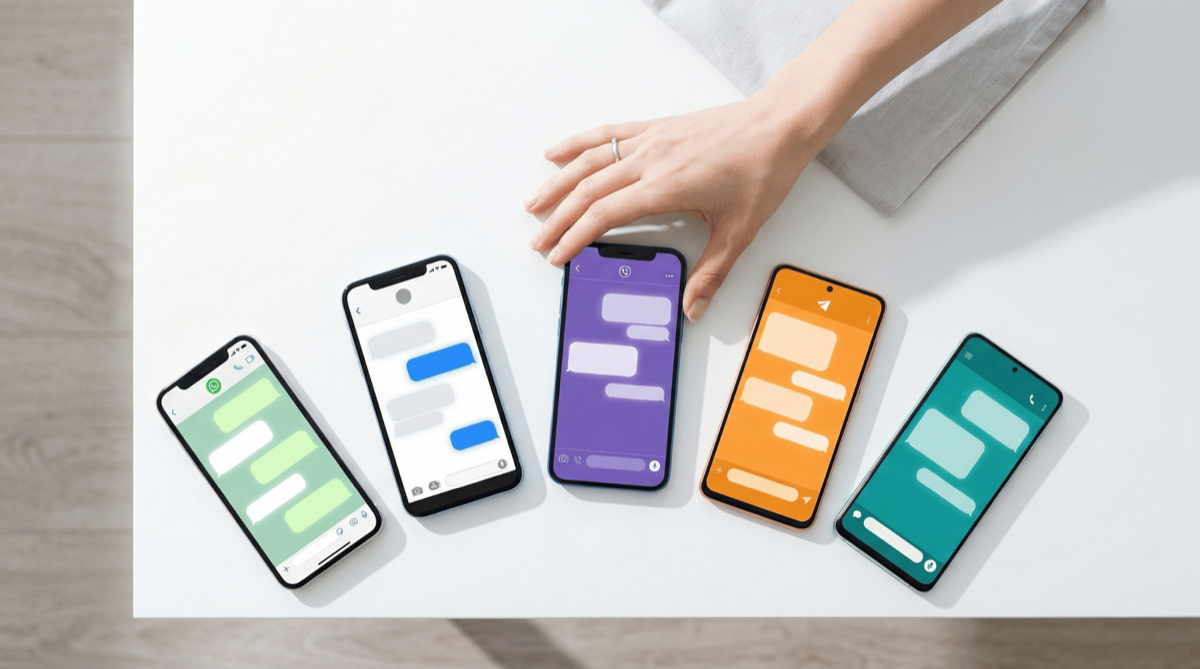
Most guides about AI customer service assume you are only using one channel — usually website chat. That advice is outdated. In 2026, small business customers send messages wherever they feel most comfortable: WhatsApp, Instagram DMs, Telegram, LINE, or your website. A 2026 global study by Kantar and Meta found that 73.3% of consumers prefer messaging when communicating with a business, and 66.8% feel frustrated when messaging is not available as a contact option.
The question is not whether to use messaging. It is which channel to start with, when to add more, and how to avoid spreading yourself too thin. This guide provides a practical framework for choosing the right messaging channel for your AI agent based on where your customers actually are, not where the technology is trending.
Why Does Channel Choice Matter for AI Agents?
The messaging channel you choose determines three things: who can reach you, what your AI agent can do, and how much it costs to operate.
Not every channel offers the same capabilities. WhatsApp supports rich media, quick-reply buttons, and structured list messages. Instagram DMs work within a 24-hour messaging window with specific automation rules. Telegram offers the most automation-friendly environment with no per-message fees. LINE dominates specific markets where WhatsApp barely exists.
Choosing the wrong channel means building an AI agent that reaches the wrong audience — or paying message fees for a channel your customers do not use. Choosing the right one means your AI agent starts generating value from day one.
What Are the Major Messaging Channels and Who Uses Them?
Here is a factual breakdown of the five major messaging channels small businesses use in 2026, based on current platform data.
| Channel | Monthly Active Users | Strongest Regions | Best For |
|---|---|---|---|
| 3 billion+ | Global (dominant in Southeast Asia, Europe, Latin America, Middle East, Africa) | Post-enquiry lead capture, after-hours triage, order updates, customer service | |
| Instagram DM | 3 billion (platform-wide) | Global (strongest for visual discovery, retail, F&B, lifestyle brands) | Pre-sale product questions, comment-to-DM funnels, discovery-driven leads |
| Telegram | 1 billion+ | Global (strong in tech-forward communities, Central/Eastern Europe, Middle East) | Community engagement, support bots, broadcast updates, automation-heavy flows |
| LINE | ~196 million | Japan, Taiwan, Thailand, Indonesia | Official Account customer service, promotions, reservations, loyalty messaging |
| Website chat | Varies by traffic | Everywhere (owned channel) | FAQ handling, lead forms, visitor engagement, controlled experience |
Sources: Meta Q1 2025 Earnings (WhatsApp), TechCrunch September 2025 (Instagram), TechCrunch March 2025 (Telegram), LY Corporation Media Guide (LINE).
The key insight from this table: your customers are not choosing between these channels. They are already on one or two of them based on geography and habit. Your job is to meet them there.
How Do You Decide Which Channel to Start With?
Start with one channel, prove it works, then expand. Here is a decision framework based on business type and customer behaviour.
Start with WhatsApp if:
Your customers already message you on WhatsApp (even manually). You operate in a market where WhatsApp is the default messaging app. Your business relies on enquiry-to-sale conversations (services, retail, F&B, professional services). You need after-hours coverage for incoming leads.
WhatsApp has the broadest global reach at 3 billion users and the deepest business messaging infrastructure. The Meta/Kantar 2026 study found that 72.4% of consumers are more likely to purchase from a brand that offers messaging — and in most markets outside East Asia, that means WhatsApp. For most small businesses, this is the strongest starting point.
Start with Instagram DM if:
Your customer acquisition happens through visual content (posts, Reels, Stories). Your business is in retail, fashion, beauty, F&B, or lifestyle. Customers frequently DM you after seeing products on your feed. You run Instagram ads with click-to-message objectives.
Instagram's strength is the discovery-to-conversation pipeline. A customer sees a product, swipes, and messages you. The AI agent's role here is to catch that interest immediately — answer the product question, qualify the lead, and either close or hand off. Average response times on Instagram exceed 10 hours without automation, while customers expect replies within minutes.
Start with Telegram if:
Your audience is tech-savvy and already uses Telegram. You need heavy automation without per-message fees. You run a community or broadcast-style business (courses, memberships, subscriptions). You want the most developer-friendly bot environment.
Telegram's advantage is zero per-message fees and a highly permissive bot API. For businesses that send high volumes of updates, reminders, or structured content, Telegram is the most cost-effective channel. Its limitation is smaller market penetration outside tech-forward communities.
Start with LINE if:
Your customers are in Japan, Taiwan, or Thailand. You need an Official Account for local credibility. Your competitors are already on LINE. Your business model relies on repeat customers and loyalty.
LINE accounts for 95.7% of messaging app usage in Taiwan and dominates Japan with over 97 million users. If your customers are in these markets, LINE is not optional — it is the primary channel. Everywhere else, it is largely irrelevant.
Always include website chat:
Regardless of which messaging channel you choose as your primary, website chat should be active from day one. It is the only channel you fully own — no algorithm changes, no per-message fees, no platform rules. It captures visitors who find you through search, ads, or referrals and may not use the same messaging app you focus on.
Should You Use One Channel or Multiple Channels?
The honest answer: start with one, add channels only when you have evidence of demand.
The case for starting with a single channel. Setting up an AI agent properly on one channel takes effort — uploading business information, configuring conversation flows, testing responses, setting handoff rules. Doing this across four channels simultaneously means doing all of them poorly. A single well-configured channel outperforms four half-configured ones.
The case for expanding. Once your primary channel is running smoothly and you have data showing enquiries coming from other channels (customers asking "Can I message you on WhatsApp?" in your Instagram DMs, for example), adding a second channel is straightforward — especially if your AI agent platform supports multiple channels from a single dashboard.
The practical pattern most small businesses follow:
- Month 1–2: Deploy AI agent on primary channel (usually WhatsApp or website chat) plus website chat widget. Test, refine, measure.
- Month 3–4: Review where else enquiries are coming from. Add the second-highest demand channel.
- Month 5+: Evaluate whether a third channel adds meaningful volume or just adds complexity.
Several AI agent platforms support this phased, multi-channel approach. Here is how they compare for small businesses expanding from one channel to two or more:
| Platform | Channels Supported | Multi-Channel Setup | Starting Price |
|---|---|---|---|
| Omago | Web chat, WhatsApp, Telegram | Single config deploys to all channels | Free (web); $99/mo (WhatsApp + Telegram) |
| Tidio | Web chat, Instagram, Facebook Messenger, email | Shared inbox across channels | Free (limited); $29/mo (Starter) |
| respond.io | WhatsApp, Instagram, Telegram, Facebook, LINE, email | Unified inbox with routing workflows | $79/mo (Starter) |
The common pattern: you configure your AI's knowledge base and conversation flows once, then connect additional channel endpoints as demand justifies expansion. Setup typically takes 15 to 20 minutes for a basic deployment on any of these platforms.
How Does Channel Choice Affect Cost?
This is the part most guides skip. Different channels have fundamentally different cost structures, and ignoring this leads to budget surprises.
| Channel | Platform Fee | Per-Message Fee | Key Cost Consideration |
|---|---|---|---|
| Website chat | Included in platform subscription | None | Lowest cost channel — unlimited messages within plan |
| WhatsApp (API) | Platform subscription required | $0.01–$0.07+ per message (varies by type and region) | Marketing messages cost 5–7x more than service messages; customer service within 24-hour window is free |
| Instagram DM | Platform subscription required | None (Meta API) | 24-hour messaging window; 200 DM per hour limit |
| Telegram | Platform subscription required | None | Most cost-effective for high-volume messaging |
| LINE | Platform subscription + LINE Official Account fee | Free tier available; paid tiers for higher volume | Official Account costs vary by market |
The hidden cost of WhatsApp: Many small businesses are surprised to learn that WhatsApp Business API charges per message. A marketing message sent to a customer in Hong Kong costs approximately $0.07, while a utility message costs about $0.01. Service conversations within a 24-hour customer-initiated window are free. This means an AI agent that responds to incoming customer queries costs very little in WhatsApp fees — but sending proactive marketing messages adds up.
The cost advantage of Telegram and website chat: Both channels have zero per-message fees. If your primary use case is customer service (responding to enquiries, not sending outbound marketing), Telegram and website chat are the most budget-friendly options. WhatsApp's value comes from its massive reach and customer preference, which often justifies the per-message cost.
What About Channels That Are Coming Soon?
The messaging landscape is not static. Platforms add business features regularly, and new channel integrations launch throughout the year. Most AI agent platforms expand their channel support over time — for example, respond.io added TikTok messaging, while platforms like Omago and Tidio continue to extend their integration lists. LINE support is particularly relevant for businesses serving customers in Japan, Taiwan, or Thailand who want to consolidate channels on one platform.
If your AI agent platform announces support for a channel you have been watching, the expansion is typically seamless — same AI configuration, same conversation flows, new channel endpoint. The work you invest in configuring your AI carries over to every new channel you add.
The practical advice: do not wait for a channel that is not available yet. Start with what is live, build your AI agent properly, and expand when new channels become available. A well-configured AI agent on one channel today is worth more than a half-configured agent on four channels next quarter.
Frequently Asked Questions
Can one AI agent respond on WhatsApp, Telegram, and website chat simultaneously?
Yes. Most modern AI agent platforms operate across multiple messaging channels from a single configuration. You upload your business information and set your conversation flows once, and the AI responds consistently regardless of which channel the customer uses. The customer experience is the same whether they message via WhatsApp at 9 PM or through your website widget at 3 PM.
Which channel has the highest conversion rate for small businesses?
WhatsApp consistently shows the highest engagement and conversion rates among messaging channels. WhatsApp messages achieve 90–98% open rates compared to 15–25% for email. A respond.io case study on Homage, a home-care services company operating in Singapore, Malaysia, and Australia, found that automating WhatsApp notifications and follow-ups saved roughly 50 hours per month and improved care-visit success rates by 9%. However, conversion depends more on response speed than channel choice — the channel where you reply fastest will convert best.
Is it worth paying WhatsApp per-message fees when Telegram is free?
It depends on where your customers are. If your customers already use WhatsApp (which is the case in most markets outside East Asia), paying per-message fees for WhatsApp will generate more business than free messaging on a channel your customers do not use. The cost of a WhatsApp service conversation is minimal — customer-initiated conversations within a 24-hour window are free under the current pricing model.
How do I know if my customers want me on a specific channel?
Look at two data points: where customers currently message you (check your Instagram DMs, WhatsApp, website contact forms), and where they ask to reach you ("Do you have WhatsApp?" in an email, or "Can I message you on LINE?" in a phone call). If more than 10% of your enquiries mention a specific channel, that channel is worth adding.
What if my customers are spread across multiple channels and regions?
This is the strongest case for a multi-channel AI agent. If you serve customers in Thailand (LINE), Europe (WhatsApp), and attract leads through Instagram globally, a platform that supports all channels from one dashboard prevents you from managing separate tools for each. Configure once, deploy everywhere, and let customers choose their preferred channel.
Sources: Meta Q1 2025 Earnings Call (WhatsApp 3B MAU), TechCrunch September 2025 (Instagram 3B MAU), TechCrunch March 2025 (Telegram 1B users), LY Corporation Media Guide (LINE MAU), Meta/Kantar State of Business Messaging 2026, respond.io / Homage Case Study, WhatsApp Business Platform Pricing.