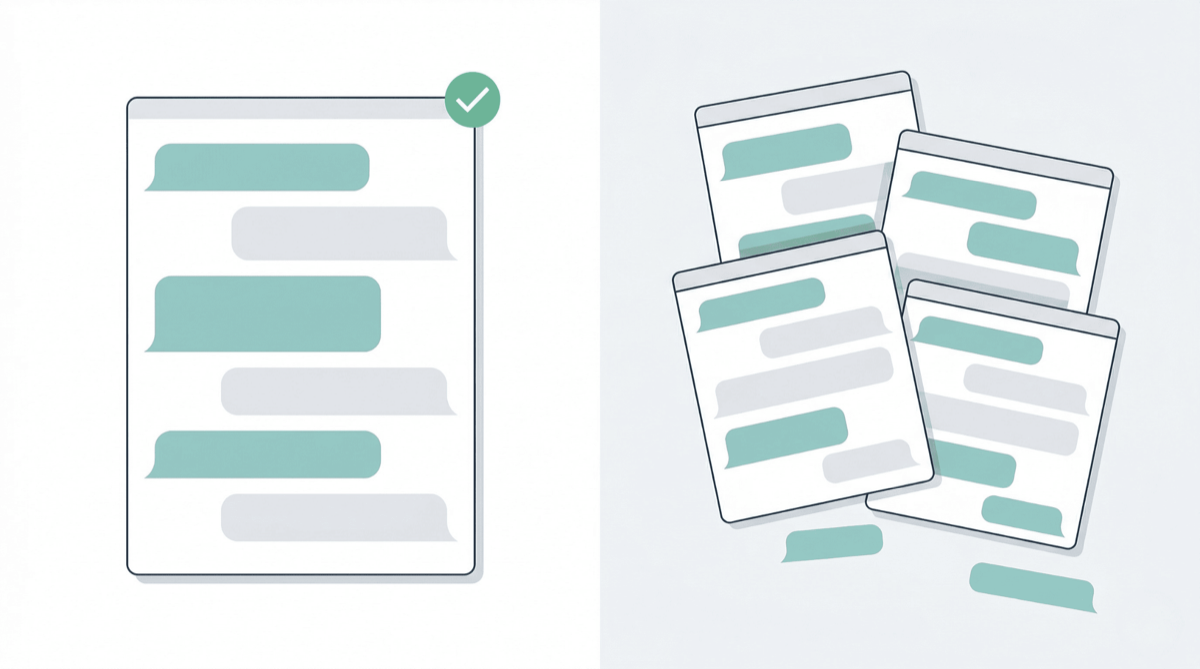
The advice most AI agent vendors give is predictable: connect every channel immediately. WhatsApp, Instagram, Telegram, website chat, LINE — all at once. More channels means more coverage, which means more leads. In theory.
In practice, most small businesses that launch on four channels simultaneously end up with four half-configured AI agents that give inconsistent answers, create fragmented customer experiences, and generate more work than they eliminate. The businesses that get the best results almost always start with one channel, prove the AI works, then expand deliberately.
This guide explains when a single-channel approach is the right move, when multi-channel becomes necessary, and how to expand without breaking what already works.
What Is the Difference Between Single-Channel and Multi-Channel AI Agents?
A single-channel AI agent operates on one messaging platform — typically WhatsApp, website chat, or Telegram. Every customer conversation happens in the same place, through the same interface, with the same set of rules.
A multi-channel AI agent operates across two or more platforms from a single configuration. A customer can message on WhatsApp at 9 PM, follow up through your website widget the next morning, and the AI maintains context and consistency across both.
The distinction is not just about reach. It affects configuration effort, cost, team workflow, and the quality of customer experience your AI delivers.
Why Do Most Small Businesses Start with One Channel?
The practical reason is focus. Setting up an AI agent properly on a single channel requires real effort.
You need to upload accurate business information — pricing, hours, services, policies, FAQs. You need to build conversation flows for common scenarios: lead qualification, booking enquiries, product questions. You need to test the AI against real customer queries and refine responses that miss the mark. You need to define handoff rules for situations the AI should not handle.
Doing this well on one channel takes 2 to 4 hours of focused configuration. Doing it across four channels simultaneously does not take 4 times longer — it takes 4 times longer while also introducing inconsistencies, because you are splitting attention instead of getting one channel right.
According to the OECD, generative AI is in use in 30.7% of SMEs globally, but adoption is heavily concentrated in simple, single-use-case deployments. The businesses seeing measurable results are the ones that narrowed their focus, not the ones that tried to automate everything at once.
When Does a Single-Channel AI Agent Make Sense?
A single-channel approach is the right starting point if any of the following are true.
Your customers primarily use one messaging platform. If 80% of your inbound enquiries come through WhatsApp and the rest trickle in through Instagram or email, starting with WhatsApp covers the majority of your volume. The remaining 20% can wait until your primary channel is running smoothly.
You are deploying AI for the first time. The learning curve for AI agent configuration is real — not steep, but real. Understanding how the AI interprets questions, how conversation flows guide customers, and how handoff rules work is easier when you are observing one channel instead of juggling several.
Your team is small (1 to 5 people). Every channel you add is another inbox to monitor, another set of escalated conversations to review, another place where the AI might need adjustment. For small teams, consolidating on one channel keeps operations manageable.
Your budget is limited. Some channels carry per-message fees (WhatsApp), while others are free (Telegram, website chat). Starting with a single free channel — like a website widget — lets you validate the AI before committing to paid messaging integrations.
When Does Multi-Channel Become Necessary?
There are clear signals that a single channel is no longer enough.
Customers are explicitly asking for another channel. If you receive messages saying "Do you have WhatsApp?" on your website chat, or "Can I message you on Telegram?" in your Instagram DMs, those are direct signals of unmet demand. Each of those questions represents a customer who would prefer to communicate somewhere else — and some of them will not bother switching to your preferred channel.
You are losing leads from a specific platform. If your business generates leads through Instagram content but your AI agent only operates on WhatsApp, you are asking customers to leave one platform and open another before they can get an answer. That friction kills conversion. In a 2026 global study by Kantar and Meta, 66.8% of consumers said they feel frustrated when messaging is not available as a contact option. The channel gap between discovery and conversation is where leads disappear.
Your customer base spans multiple regions. A business serving customers in Taiwan (where LINE dominates), Europe (where WhatsApp is standard), and the United States (where Instagram DMs and website chat are common) cannot effectively serve all three groups from a single channel. Multi-channel is not optional for cross-border businesses — it is infrastructure.
Your single channel is at capacity. If your WhatsApp AI agent is handling 5,000+ messages per month and you are seeing enquiries leak to other platforms, adding a second channel is not about ambition — it is about capturing conversations that are already happening elsewhere.
What Does a Smart Multi-Channel Rollout Look Like?
The most successful pattern is phased expansion based on data, not assumptions.
Phase 1: Single Channel + Website Widget (Month 1–2)
Deploy your AI agent on your highest-volume messaging channel (usually WhatsApp for most markets) plus a website chat widget. The website widget is free on virtually every platform and catches visitors who find you through search or ads.
Focus this phase entirely on quality: Are the AI's answers accurate? Do conversation flows guide customers to clear outcomes? Are handoff rules working? Is the tone right for your brand?
Measure: response accuracy, customer satisfaction signals (do people complete conversations or abandon them?), lead capture rate, handoff volume.
Phase 2: Add Second Channel (Month 3–4)
Review your data. Where are enquiries coming from that your AI does not cover? Common second-channel additions:
If you run Instagram ads or get product enquiries through DMs → add Instagram DM automation. If your audience is tech-savvy or you want zero per-message fees → add Telegram. If you serve customers in Japan, Taiwan, or Thailand → add LINE when available.
The key advantage of a well-built Phase 1: your AI configuration carries over. If your platform supports multi-channel deployment from a single dashboard, adding a second channel does not mean reconfiguring the AI — it means connecting a new endpoint to the same knowledge base and conversation flows.
Several platforms support this "configure once, deploy everywhere" pattern. Here is how the major options handle multi-channel expansion:
| Platform | Single-Dashboard Multi-Channel | Channels on Mid-Tier Plan | Approx. Mid-Tier Price |
|---|---|---|---|
| respond.io | Yes — unified inbox with routing | WhatsApp, Instagram, Telegram, Facebook, LINE, email | $79/mo (Starter) |
| Omago | Yes — single config across channels | WhatsApp, Telegram, web chat | $99/mo (Plus) |
| Tidio | Yes — shared inbox | Web chat, Instagram, Facebook Messenger, email | $29/mo (Starter) |
| Intercom | Yes — omnichannel with Fin AI | Web, WhatsApp, email, SMS, social | $29/mo + $0.99/resolution |
The key advantage of building your AI properly in Phase 1: your configuration carries over. Adding a second channel does not mean reconfiguring the AI — it means connecting a new endpoint to the same knowledge base and conversation flows.
Phase 3: Optimise and Evaluate Third Channel (Month 5+)
At this point, you have data from two channels. Ask: Is a third channel adding meaningful volume, or just adding complexity? For most small businesses, two messaging channels plus a website widget covers 90% or more of their customer communication. Adding a third channel should only happen when there is measurable demand — not because it seems like a good idea.
What Happens to Customer Context Across Channels?
This is the question that separates good multi-channel setups from bad ones.
In a poorly configured multi-channel deployment, a customer who messages on WhatsApp tonight and follows up through website chat tomorrow is treated as two separate people. The AI asks the same qualifying questions again. The customer repeats their request. The experience feels fragmented, and the business misses the connection.
In a well-configured deployment, customer context carries across channels. The AI recognises that the website visitor asking about appointment availability is the same person who enquired about services on WhatsApp last night. The conversation continues, not restarts.
Not every platform handles this well. When evaluating multi-channel AI agent platforms, ask specifically: does the platform merge customer profiles across channels? If a customer contacts you on WhatsApp and then website chat, does the team see one unified conversation history or two separate threads?
How Does Multi-Channel Affect Cost?
Adding channels increases cost in predictable ways.
Platform tier upgrades. Most platforms gate messaging channel access behind higher-tier plans. Expect to move from a free or basic tier to a mid-tier plan when adding WhatsApp or Telegram. For example, Omago requires a Plus plan ($99/month) for WhatsApp and Telegram, while respond.io starts at $79/month with omnichannel access from day one.
Per-message fees on paid channels. WhatsApp charges per template message. Telegram and website chat do not. If your second channel is Telegram, the incremental cost is effectively zero beyond the platform subscription. If it is WhatsApp, factor in per-message fees — though for customer service (responding to incoming messages), these are minimal since customer-initiated conversations within the 24-hour window are free.
No meaningful increase in configuration time. This is the counterintuitive part. If your platform supports multi-channel from a single dashboard, adding a second channel takes minutes — not hours. The configuration work (knowledge base, conversation flows, handoff rules) was already done in Phase 1. The marginal cost of a second channel is almost entirely the platform fee, not your time. iMotorbike, a motorbike marketplace in Malaysia and Vietnam, connected WhatsApp, Facebook Messenger, Instagram, and TikTok to a single respond.io inbox. Their AI agents now handle over 70% of conversations, and the company manages twice as many leads daily compared to before implementation — with a 67% improvement in response time.
What Mistakes Do Small Businesses Make with Multi-Channel?
Three patterns show up repeatedly.
Launching on too many channels at once. The business configures AI on WhatsApp, Telegram, Instagram, website chat, and LINE simultaneously. None of them get tested properly. The AI gives wrong answers on one channel and the business does not notice for weeks because they are monitoring five dashboards.
Inconsistent information across channels. The AI on WhatsApp has the updated price list but the website widget still references old pricing because the business forgot to update both. Customers get different answers depending on where they ask — which damages trust faster than having no AI at all.
Adding channels without demand. The business adds Telegram because it is free, even though zero customers have ever asked about Telegram. The channel sits empty, adding complexity to the dashboard without generating a single conversation. Channel expansion should follow customer demand, not platform availability.
Frequently Asked Questions
Should I start with WhatsApp or website chat?
Start with whichever channel generates more inbound messages right now. If customers already message you on WhatsApp, that is your first channel. If most enquiries come through your website contact form, start with a website chat widget. The goal is to automate your highest-volume channel first, then expand.
Can I use different AI configurations for different channels?
Most platforms use a single AI configuration across all channels, which ensures consistency. Some allow channel-specific customisations — for example, a shorter greeting on Telegram versus a more detailed welcome message on your website widget. The core knowledge base and conversation flows should remain the same across channels to avoid conflicting answers.
How do I know when it is time to add a second channel?
Look for three signals: customers explicitly asking about another channel, leads arriving on a platform your AI does not cover, or your single channel approaching its message limit. If at least one of these is present and your primary channel is running smoothly (accurate answers, good lead capture, low handoff rate on routine queries), you are ready.
What if I serve customers in different countries with different messaging preferences?
This is the strongest case for multi-channel. If your customers in Southeast Asia prefer WhatsApp, your customers in Taiwan use LINE, and your website attracts visitors globally, a multi-channel AI agent is not a luxury — it is a requirement. The key is to phase the rollout: start with the channel serving your largest customer segment, then add the next.
Is it better to have one great channel or three average ones?
One great channel, every time. A single well-configured AI agent that handles 90% of queries accurately, captures leads reliably, and hands off complex cases smoothly will outperform three channels where the AI gives inconsistent answers and drops leads. Quality first, coverage second.
Sources: OECD "How are SMEs using generative AI?" (2025), Meta/Kantar State of Business Messaging 2026, respond.io / iMotorbike Case Study (2× more leads, 70% AI-handled conversations, 67% faster response times), Standard Chartered Hong Kong SME Leading Business Index Q1 2026 (55% of SMEs used or plan to use AI).