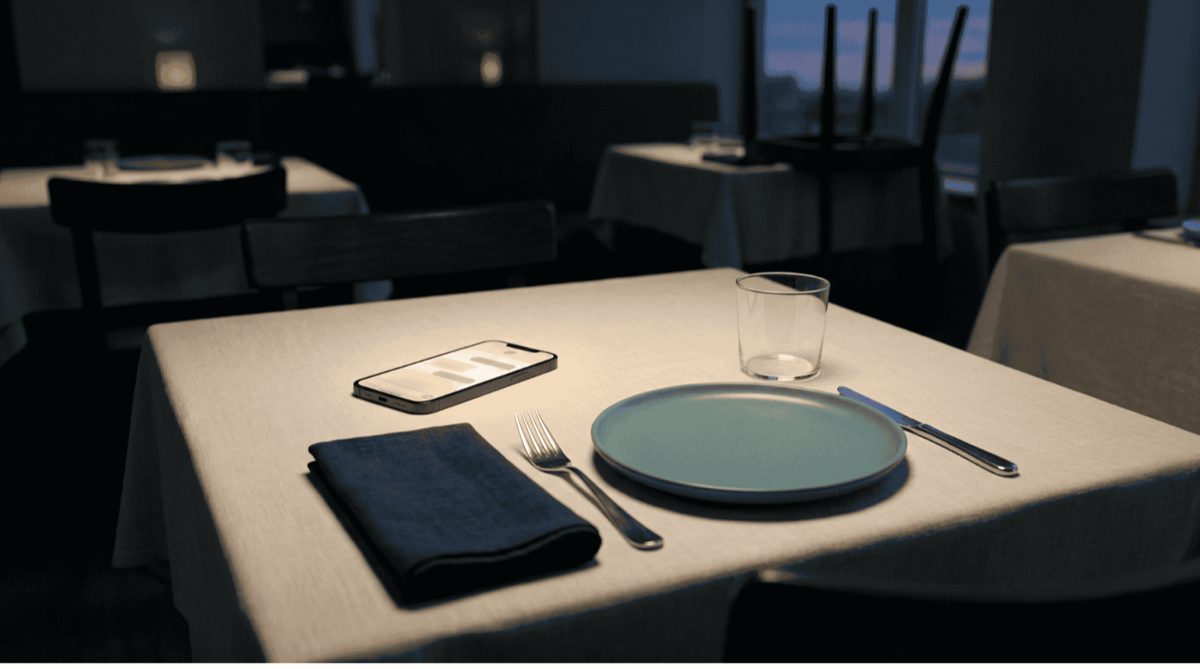
A restaurant's busiest messaging hours are the worst possible time to reply. Customers send WhatsApp messages about reservations, menu options, and delivery — mostly between 6 PM and 10 PM, when every staff member is occupied with in-house service. By the next morning, the customer who asked about a table for six has already booked elsewhere.
According to the National Restaurant Association's State of the Restaurant Industry 2026 report, 26% of restaurant operators are already using AI-related tools, and 41% plan to invest in AI technology to improve forecasting, efficiency, and customer experience. The gap between interest and adoption is closing fast — and the restaurants seeing the strongest results are the ones using AI for the simplest, highest-impact task: answering customer messages instantly.
This guide covers how restaurants are using AI agents in practice, which message types AI handles well, and what to keep away from automation.
What Do Restaurant Customers Actually Message About?
Understanding message patterns is the first step to effective automation. Restaurant enquiries cluster into six predictable categories.
Reservations are the highest-value message type. Availability for tonight, party size accommodations, special seating requests, deposit policies, changes, and cancellations. These messages often arrive in the evening when staff cannot respond — and they represent direct revenue.
Menu questions are the highest-volume type. Prices, allergen information, vegetarian or halal options, children's menus, daily specials, set menus. These questions have factual, consistent answers that AI handles with high accuracy.
Promotions and offers include coupon redemption, happy hour details, loyalty rewards, and seasonal set menus. These require up-to-date information but are straightforward for AI when the knowledge base is current.
Delivery and takeout queries cover order status, estimated arrival, address changes, minimum order amounts, and delivery zones. "Where is my order?" is one of the most common messages restaurants receive — and one of the easiest for AI to triage.
Store information includes hours, directions, parking, accessibility, and dress code. These are the most repetitive questions and the simplest for AI to automate.
Complaints about wrong items, late deliveries, food quality, and refund requests. These require human judgment and should be routed to staff immediately — not handled by AI.
How Are Restaurants Using AI Agents in 2026?
The most effective restaurant AI deployments share three characteristics: they focus on information delivery and data collection (not decision-making), they operate primarily during off-peak and after-hours periods, and they hand off anything ambiguous to a human.
Instant answers to repetitive questions
A restaurant that receives 20 WhatsApp messages per evening — half of which ask about hours, prices, or availability — can automate those 10 conversations entirely. The AI agent checks the uploaded menu, price list, and operating hours, then responds in seconds. Staff never need to see these messages.
According to IBM, AI can handle up to 80% of routine customer queries. For restaurants, where enquiries are highly repetitive and factual, the actual coverage rate is often higher.
After-hours reservation capture
A customer messages at 9:30 PM asking about a table for four on Saturday. Instead of silence until morning, the AI agent confirms availability (if connected to booking data), collects the customer's name and contact details, and either confirms the reservation or flags it for staff follow-up at opening.
This is where the revenue impact is most direct. A restaurant that recovers even two additional bookings per week from after-hours messages — at an average table value of $80 — adds over $8,000 in annual revenue.
Pre-qualification for large bookings and events
When a customer enquires about a private dining room, birthday party, or corporate event, the AI agent can collect structured information before a staff member gets involved: date, party size, budget range, dietary requirements, preferred room configuration. The staff member picks up the conversation the next morning with everything they need to close the booking — no back-and-forth.
What Should Restaurants Keep Away from AI?
Complaints and refund decisions. A customer who received the wrong dish or waited 90 minutes for delivery is frustrated. An AI-generated response — no matter how well-worded — lacks the empathy and judgment that the situation requires. The AI should acknowledge the complaint, collect relevant details (order number, what went wrong, photos if applicable), and route to a human immediately.
Custom menu modifications. "Can you make the pasta without garlic but add extra chilli, and is the sauce gluten-free if we substitute the noodles?" This requires kitchen knowledge that changes daily. AI can flag the question for human response rather than risk an inaccurate answer.
Pricing negotiations. Corporate bookings, large party discounts, and event quotes require business judgment. AI should collect the enquiry details and schedule a callback — not attempt to negotiate.
What Results Are Restaurants Actually Seeing?
| Metric | Result | Source |
|---|---|---|
| WhatsApp broadcast conversion rate | +10% increase | Eatizen/Maxim's Group case study (2025) |
| Average transaction value from AI-targeted segments | +50–100% uplift | Eatizen/Maxim's Group case study (2025) |
| Restaurant operators using AI tools | 26% | National Restaurant Association (2026) |
| Restaurants planning to invest in AI | 41% | Future Today Strategy Group (2025) |
| AI usage for customer orders specifically | 6% | National Restaurant Association (2026) |
| Phone orders handled by AI | 10% of total volume | Wingstop/ConverseNow pilot (2023) |
The contrast between the last two rows is telling: 41% plan to invest, but only 6% are using AI for ordering. This means the current sweet spot for restaurant AI is not order-taking — it is information delivery, reservation capture, and lead qualification. Wingstop's pilot with ConverseNow handles 10% of phone orders via AI and is scaling toward full coverage, but that level of voice-AI integration is still ahead of most SME budgets. Restaurants that automate the repetitive messaging workload are seeing immediate, measurable returns.
How Do You Set Up an AI Agent for a Restaurant?
The setup process for a restaurant AI agent follows a predictable pattern.
Step 1: Gather your information (15–20 minutes). Compile your menu with current prices, operating hours (including holiday variations), reservation policies, delivery zones and fees, allergen information, and directions with parking details. Most restaurant owners have this information scattered across their phone, website, and printed menus — consolidating it once is the only time-intensive step.
Step 2: Upload to your AI platform (5–10 minutes). Platforms like Omago, SleekFlow, and Respond.io let you upload text files, paste content, or link your website. The AI reads and indexes your information to build its knowledge base. No coding required. Omago offers hands-on setup support; SleekFlow and Respond.io provide more self-service workflows with broader CRM integrations. Choose based on whether you want guided onboarding or prefer to configure independently.
Step 3: Build conversation flows for key scenarios (10–15 minutes). For reservations, create a flow that asks for date, party size, time preference, and contact details. For delivery enquiries, create a flow that confirms the delivery zone and collects the order details. These guided conversation flows ensure consistent outcomes regardless of how the customer phrases their request.
Step 4: Set handoff rules. Define which topics the AI handles (menu, hours, reservations, promotions) and which trigger an immediate handoff to staff (complaints, refunds, large event enquiries). This is the most important configuration decision — it protects your customer experience on sensitive interactions.
Step 5: Test with real questions. Before going live, send the AI 10–15 questions that your restaurant actually receives. Check for accuracy, tone, and whether the handoff rules trigger correctly.
Frequently Asked Questions
How many messages does a typical restaurant receive per week on WhatsApp?
This varies significantly by size and location, but a busy restaurant in an urban area commonly receives 50 to 150 WhatsApp messages per week, with peaks on Thursday through Sunday evenings. Even a smaller establishment typically receives 15 to 30 messages per week — enough to justify automation if a meaningful portion arrives after hours.
Can AI handle reservation confirmations?
AI can collect all the information needed for a reservation (date, time, party size, contact details) and either confirm directly if integrated with booking data, or send a structured summary to staff for manual confirmation. The second approach is more common among small restaurants that do not use digital reservation systems — and it still saves significant time compared to manual back-and-forth messaging.
What if my menu changes frequently?
Update your AI's knowledge base whenever the menu changes. For restaurants with daily specials or seasonal rotations, this means a quick update once or twice per week — typically 5 to 10 minutes. The key rule: outdated information in AI is worse than no AI, because customers will act on incorrect answers. If a dish is sold out or a price has changed, the AI needs to reflect that immediately.
Is AI appropriate for fine dining restaurants?
Yes, but the tone and scope should match the experience. A fine dining restaurant might use AI only for initial enquiry acknowledgment and information collection, with every substantial interaction handled by a maître d' or reservations manager. The AI's role is to ensure no enquiry goes unanswered after hours — not to replace the personal touch that defines the dining experience.
How much does a restaurant AI agent cost?
Platform costs range from free (basic web widget with limited messages) to $99–$369 per month for full messaging channel integration and higher message volumes. WhatsApp per-message fees for customer service conversations (where the customer messages first) are free within the 24-hour window. For most restaurants, the monthly cost is less than a single evening's table revenue — and the AI operates every evening, weekend, and holiday without overtime.
Sources: National Restaurant Association State of the Restaurant Industry 2026, Future Today Strategy Group Hospitality Report (2025), Eatizen/Maxim's Group case study via Omnichat (2025), IBM — AI Customer Service Chatbots, Wingstop/ConverseNow AI case study, WhatsApp Business — Piedra Nómada, WhatsApp Business — JJMehta Camera Store.